


















7 Essential LOTOTO Devices and Solutions
- Posted on
- By Marit Krol
- Posted in ball valve, butterfly valve, group loto, lockout tagout, loto devices, safety padlocks
- 0

Discover seven essential LOTOTO devices and solutions for safe machine maintenance, including safety padlocks, group lockout devices, warning tags, energy-specific lockouts, shadow boards, pipe identification, and digital LOTOTO systems. Learn how each solution supports hazardous energy control, secures energy-isolating devices, and helps prevent unexpected machine startup.
Effective hazardous energy control is essential during machine maintenance, servicing, and repair. Lockout-Tagout-Tryout (LOTOTO) procedures help prevent unexpected machine startup and the uncontrolled release of stored energy.
Choosing appropriate LOTOTO devices depends on the machinery, energy sources, isolation points, and number of employees involved. Some devices secure energy-isolating equipment, while others support hazard identification, group protection, and procedure management.
What Is LOTOTO Equipment?
LOTOTO stands for Lockout-Tagout-Tryout, a hazardous energy control procedure involving three essential activities:
Lockout: Securing an energy-isolating device in its safe position to prevent unintended operation.
Tagout: Attaching warning tags identifying the responsible employee and indicating that equipment must not be operated.
Tryout: Verifying that energy isolation is effective and the machinery cannot start unexpectedly.
LOTOTO equipment includes safety padlocks, lockout hasps, group lockout boxes, electrical and valve lockouts, safety tags, and supporting identification and documentation systems.
Energy isolation and lockout are different actions. First, a suitable energy-isolating device, such as a disconnect switch or isolation valve, is operated to isolate the energy source. Lockout equipment then secures that device in the safe position.
Any hazardous stored or residual energy must also be controlled, and the effectiveness of isolation verified before work begins.
1. Safety Padlocks: Securing Energy-Isolating Devices

Key functions:
• Secure energy-isolating devices against unintended operation.
• Maintain individual lockout protection.
• Identify authorized employees.
• Support controlled key management.
Safety padlocks are fundamental LOTOTO devices used to secure isolation points during maintenance. Unlike general-purpose padlocks, they are specifically designated for hazardous energy control.
They are available in composite, nylon, aluminium, and steel configurations, with different shackle lengths and identification options. Selection depends on the isolation device, operating environment, and approved procedure.
Safety Padlock Key Systems
Three commonly used key configurations are:
Keyed Alike (KA): Multiple padlocks operate with the same key, allowing one authorized employee to manage several assigned locks.
Keyed Different (KD): Each padlock has a different key combination, supporting individual control and reducing unintended cross-operation.
Master Keyed (MK): Individual padlocks have separate operating keys but can also be opened with a designated master key. Master-key access must follow strict authorization and lock removal procedures.
Application Example
During conveyor maintenance, a technician operates the designated electrical disconnect switch to isolate the power supply. The technician then applies a personal safety padlock to secure the switch in the OFF position. After controlling residual energy and verifying isolation, maintenance can begin.
Examples of Padlocks
Master Lock 410RED Zenex Safety Padlock
A lightweight composite padlock used to secure compatible energy-isolating devices during machinery maintenance. Its durable construction and key-retaining design support individual lockout protection.
Master Lock 410LTTEAL Long-shackle Safety Padlock
A composite-body safety padlock with an extended metal shackle, suitable for compatible energy-isolating devices requiring additional shackle clearance. Its lightweight body and key-retaining design support personal lockout applications.
ABUS 74BS/40 Aluminium Safety Padlock
An aluminium safety padlock with a protective composite cover, used to secure isolation points in industrial environments. Its robust construction supports repeated maintenance applications.
2. Group Lockout Devices: Protecting Multiple Maintenance Workers

Key functions:
• Protect multiple employees during maintenance.
• Allow individual padlocks on shared lockout arrangements.
• Prevent premature access to isolation keys.
• Coordinate work involving multiple energy sources.
Group lockout devices support hazardous energy control when several authorized employees work on the same machine or installation. Two common solutions are lockout hasps and group lockout boxes:
Lockout Hasps
Lockout hasps allow several workers to attach personal padlocks to one secured isolation point. The hasp cannot be released until all attached locks have been removed.
Steel hasps are commonly used in industrial environments, while non-conductive nylon designs provide an alternative for suitable applications.
Group Lockout Boxes
Group lockout boxes are particularly useful when several isolation points are involved. Under an established procedure, authorized personnel secure the isolation devices and place the relevant keys inside the box.
Each exposed authorized employee then applies a personal lock to the box, preventing access to the keys while their protection is required.
Application Example
During production-line servicing, electricians and mechanical technicians work simultaneously. Personal locks on a hasp protect a shared isolation point, while a group lockout box controls keys for other secured isolation points.
Examples of Group Lockout Devices
Lockout Hasp
Master Lock 420 Steel Lockout Hasp
A steel hasp that allows multiple workers to attach personal padlocks to one isolation point. It is useful during team maintenance because the hasp cannot be removed until all attached locks have been removed.
Master Lock 428 Nylon Lockout Hasp
A non-conductive nylon hasp designed for group lockout applications. It enables multiple employees to maintain individual protection while offering a non-conductive alternative to metal hasps.
Group Lockout Boxes
Master Lock 498A Portable group lockout box.
A portable box used to secure the keys associated with locked isolation points. It supports coordinated maintenance involving multiple employees while maintaining personal lockout protection.
ABUS B835 Safety Redbox Group lockout box with quick-release functionality.
A group lockout box designed to manage isolation keys during team maintenance. Its mounting arrangement supports convenient use at designated maintenance locations.
3. Lockout Tags and Labels: Communicating Safety Information

Key functions:
• Warn against operating equipment under maintenance.
• Identify the responsible employee.
• Communicate the reason for isolation.
• Display relevant maintenance information.
Lockout tags communicate that machinery must not be operated during servicing. They commonly display warnings such as "Do Not Operate" or "Do Not Energize," alongside employee identification and maintenance details.
Tags should remain legible, securely attached, and suitable for the working environment. Standardized colors and messages improve recognition across industrial facilities.
Lockout tags do not provide physical restraint. Under OSHA 29 CFR 1910.147, tagout-only arrangements are subject to specific conditions and may require additional protective measures.
Application Example
During packaging-machine servicing, a technician attaches a warning tag to the locked electrical isolator. The tag identifies the responsible employee and clearly communicates that the equipment must remain out of service.
Examples of Lockout Tags and Labels
Master Lock 497: Laminated "Do Not Operate" warning tags.
Laminated warning tags used to identify equipment undergoing maintenance. Their grease- and dirt-resistant construction helps maintain message visibility in industrial environments.
Brady 307665: Rewritable safety tags.
Rewritable safety tags used to communicate maintenance information and identify responsible employees. They support clear identification during recurring lockout activities.
4. Energy-Specific Lockout Devices: Securing Different Isolation Points

Key functions:
• Secure compatible electrical and mechanical isolation points.
• Prevent unintended operation of isolating devices.
• Accommodate different valve and switch configurations.
• Support machine-specific energy control procedures.
Energy-specific lockout devices secure isolation points associated with different hazardous energy sources. Device selection depends on the equipment's physical configuration and the type of isolation required.
Different Types of Energy-Specific Lockout Devices
Electrical Lockout Devices
Electrical lockout devices secure circuit breakers, disconnect switches, and other suitable electrical isolation points in the OFF position. Common examples include miniature circuit breaker lockouts and electrical plug lockouts.
Valve Lockout Devices
Valve lockouts prevent the operation of isolated valves controlling liquids, gases, or steam. Different designs are available for ball valves, gate valves, and butterfly valves. Depending on the system, these devices may support the control of hydraulic, pneumatic, or thermal hazards.
Pneumatic Lockout Devices
Pneumatic lockouts secure suitable compressed-air isolation points to prevent unintended reconnection or operation. Residual pressure must also be released or otherwise controlled before maintenance begins.
Cable Lockout Devices
Cable lockouts use a flexible cable to secure certain complex or irregularly shaped isolation arrangements. Depending on the configuration, they may be used with isolation points associated with electrical, mechanical, hydraulic, or pneumatic energy.
However, cable lockouts are not suitable for every application. Compatibility with the energy-isolating device, locking configuration, and operating conditions must always be verified.
Application Example
Before replacing a component in a compressed-air system, a technician closes the designated air isolation valve and secures it using a compatible valve lockout device and safety padlock. The technician then releases residual pressure according to the procedure and verifies that hazardous energy has been controlled before starting work.
Examples of Lockouts
Master Lock S2394 Universal Miniature Circuit Breaker Lockout for Electrical Energy
A universal miniature circuit breaker lockout used to secure compatible breakers in the OFF position. Its tool-free installation supports efficient electrical maintenance preparation.
Master Lock S3081 Adjustable Ball Valve Lockout for Hydraulic, Pneumatic, and Thermal Energy
An adjustable ball valve lockout used to secure compatible isolation valves controlling liquids, gases, or steam. Its adjustable design accommodates different valve configurations, reducing the need for multiple fixed-size devices.
Master Lock S806 for Multiple Hazardous Energy types
A flexible cable lockout used to secure compatible valves or circuit breakers, including arrangements with multiple isolation points. Its adjustable cable and multiple padlock holes support applications where the geometry permits reliable locking.
Master Lock S3900 for Pneumatic Energy
A stainless-steel device designed to prevent compatible compressed-air fittings from being reconnected during maintenance. Its corrosion-resistant construction supports use in industrial environments.
These products do not contain or isolate hazardous energy themselves. They secure suitable energy-isolating devices or disconnected fittings, while the applicable maintenance procedure addresses energy isolation, stored energy, and verification.
5. LOTOTO Shadow Boards: Organizing Safety Equipment

Key functions:
• Provide designated storage for LOTOTO equipment.
• Make missing tools easier to identify.
• Improve equipment accessibility.
• Support consistent maintenance preparation.
LOTOTO shadow boards organize safety padlocks, hasps, tags, and other lockout equipment at designated storage locations.
Tools are arranged in clearly marked positions, allowing maintenance personnel to identify available equipment and recognize missing items before work begins.
Shadow boards are particularly useful where multiple maintenance teams share equipment. They support organization but do not themselves isolate or secure hazardous energy.
Application Example
In a food-processing facility, technicians collect the required padlocks, hasps, and warning tags from a shadow board before servicing production equipment. After completing maintenance and the authorized restoration procedure, reusable devices are returned to their assigned positions.
Examples of Shadowboards
Custom-Made LOTOTO Shadow Board
A customizable magnetic storage board for organizing safety padlocks, hasps, tags, and other LOTOTO equipment. It improves equipment visibility and helps maintenance teams identify missing tools.
Shadow Board with ABUS 74/40 Safety Padlocks
A storage station supplied with ABUS safety padlocks. It provides designated positions for padlocks, supporting organized equipment distribution and retrieval.
Shadow Board with Master Lock 410 Safety Padlocks
A shadow board equipped with Master Lock 410 padlocks, suitable for maintenance departments using standardized personal lockout equipment. It makes padlocks readily accessible and simplifies visual inventory checks.
Shadow Board with Brady Nylon Safety Padlocks
A storage station equipped with Brady nylon safety padlocks in selectable quantities and colors. It supports organized storage and consistent availability of personal lockout equipment.
6. Pipe and Energy Identification: Recognizing Hazardous Energy Sources

Key functions:
• Identify pipeline contents.
• Communicate flow direction where applicable.
• Help distinguish energy and process systems.
• Support maintenance planning and hazard identification.
Pipe markings help maintenance personnel recognize the contents of industrial pipelines carrying water, compressed air, steam, gases, and other substances.
They commonly use text, colors, symbols, and directional arrows. Appropriate markings should reflect the actual contents, associated hazards, and applicable identification requirements.
Pipe identification supports energy control planning but cannot verify if a system is safely isolated.
Application
During valve replacement in a processing facility, pipe markings help technicians distinguish nearby process lines and confirm the intended system against approved drawings and isolation procedures.
Examples of Commonly Used Industrial Pipe Markings
Identify water distribution pipelines, helping distinguish utility water systems from adjacent process lines.
Identify compressed-air lines associated with pneumatic equipment and distribution systems.
Identify pipelines associated with potential thermal and pressure hazards.
Identify gas distribution systems and support substance-specific hazard recognition.
Distinguish designated sprinkler and fire protection pipework from other utility systems.
For chemicals, flammable liquids, acids, alkalis, and other applications requiring substance-specific identification, explore the industrial pipe marking solutions at Lockout-Tagout-Shop.
Pipe markers should be selected according to the actual pipeline contents, applicable identification requirements, operating environment, and required hazard information.
7. Digital LOTOTO Systems: Managing Energy Control Procedures
Key functions:
• Maintain machine-specific isolation procedures.
• Document energy sources and isolation points.
• Centralize maintenance safety instructions.
• Support procedure updates and reporting.
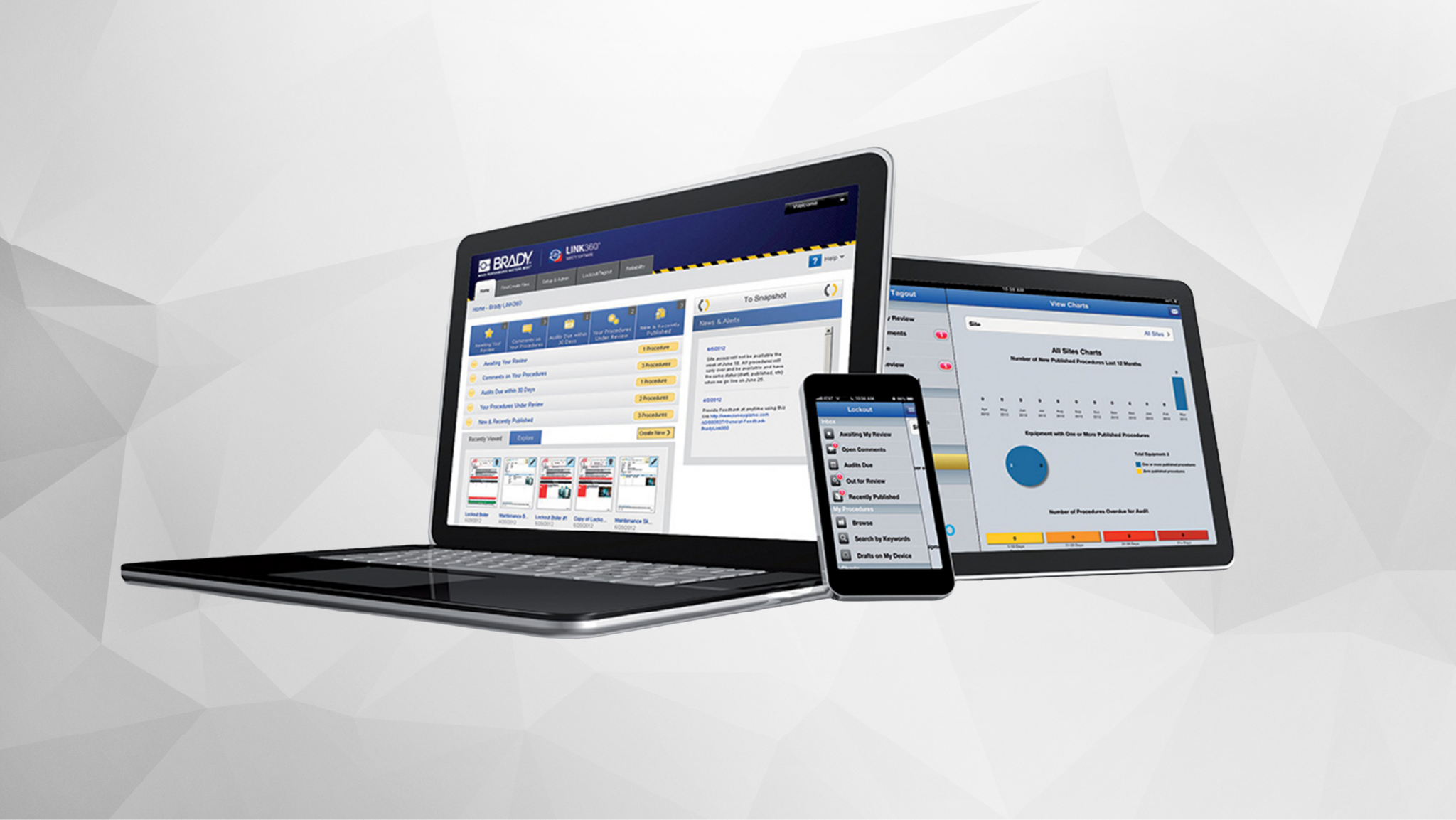
Digital LOTOTO software helps organizations manage hazardous energy control information across machinery, departments, and facilities.
Depending on the platform, users can access visual isolation instructions, equipment records, procedure revisions, and maintenance documentation.
Centralized information is particularly useful for facilities with complex machinery or numerous energy isolation points.
Application Example
A manufacturing facility operates multiple production lines with electrical, hydraulic, and pneumatic systems. Before maintenance, technicians access digital LOTOTO procedures showing the machine's energy sources, isolation locations, and verification requirements. Completed activities are recorded to support documentation and subsequent procedure reviews.
LOTOTO Software Example
A cloud-based Lockout-Tagout management platform for creating and maintaining visual, machine-specific energy control procedures.
It supports centralized documentation, procedure updates, and safety program reporting. Access across supported devices helps authorized personnel retrieve relevant instructions and allows safety managers to review procedure documentation.
Brady LINK360 supports the administrative management of LOTOTO but does not replace physical energy isolation, lockout hardware, or verification.
Conclusion: Why Selecting the Right LOTOTO Equipment Matters
The effectiveness of a LOTOTO procedure depends on identifying hazardous energy sources, operating suitable energy-isolating devices, securing them against unintended operation, and verifying that energy has been controlled.
Safety padlocks, hasps, group lockout boxes, and energy-specific lockouts provide physical protection at suitable isolation points. Tags, shadow boards, pipe identification, and digital software support communication, equipment organization, and procedure management.
Selecting compatible LOTOTO equipment and combining it with documented procedures, employee training, and periodic inspections supports safer machine maintenance.
Frequently Asked Questions About LOTOTO Devices and Equipment
1. What is the difference between Lockout-Tagout and LOTOTO?
Lockout-Tagout focuses on securing energy-isolating devices and communicating that equipment must not be operated. LOTOTO adds an explicit Tryout step to emphasize verification that hazardous energy has been effectively isolated. Verification is also a requirement under OSHA's hazardous energy control standard, even when the procedure is referred to as Lockout-Tagout.
2. What are the most important LOTOTO devices?
Common LOTOTO devices include safety padlocks, lockout hasps, group lockout boxes, electrical lockout devices, valve lockouts, pneumatic lockouts, and warning tags. The appropriate selection depends on the machinery, hazardous energy sources, and energy-isolating devices involved.
3. Do LOTOTO devices physically isolate hazardous energy?
Not necessarily. Hazardous energy is first isolated using a suitable energy-isolating device, such as an electrical disconnect switch or isolation valve. Lockout equipment then secures that device in its safe position to prevent unintended operation. Stored energy must also be controlled, and effective isolation verified before maintenance begins.
4. Can a lockout tag replace a safety padlock?
A lockout tag provides a warning but does not physically prevent operation of an energy-isolating device. Under OSHA 29 CFR 1910.147, lockout is generally required when an energy-isolating device is capable of being locked out, unless the employer demonstrates that an applicable tagout system provides equivalent protection and satisfies the relevant requirements.
5. Are cable lockout devices suitable for every isolation point?
No. Cable lockouts can accommodate certain complex or irregularly shaped isolation arrangements, but they are not universally suitable. Compatibility must be checked against the energy-isolating device, its dimensions, locking mechanism, and operating conditions.
6. What is the difference between a lockout hasp and a group lockout box?
A lockout hasp allows multiple employees to attach personal padlocks directly to a shared isolation point. A group lockout box secures the keys associated with locked isolation points, allowing multiple employees to maintain individual protection through personal locks on the box.
7. How do you choose the correct LOTOTO equipment?
Selection begins by identifying the machine's hazardous energy sources and corresponding energy-isolating devices. The lockout equipment must be compatible with those devices and suitable for the operating environment. Factors such as dimensions, material durability, personal identification, key management, and the number of workers involved should also be considered.
8. Can digital LOTOTO systems replace physical lockout devices?
No. Digital LOTOTO systems support procedure management, equipment identification, and maintenance documentation, but they do not replace physical energy isolation or lockout devices. They should be used as supporting tools within an established hazardous energy control program.
Comments
Be the first to comment...