

















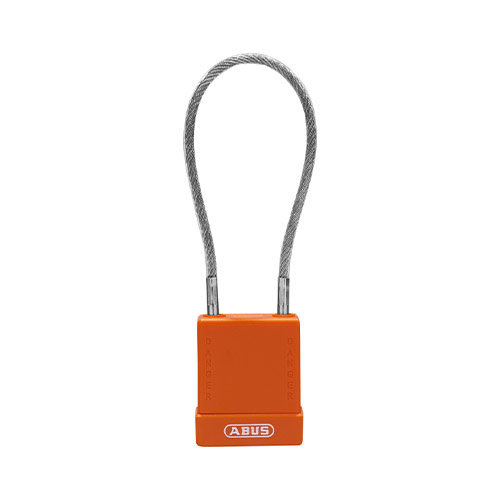
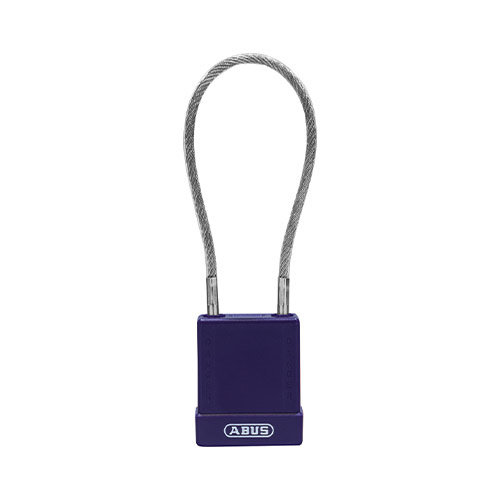


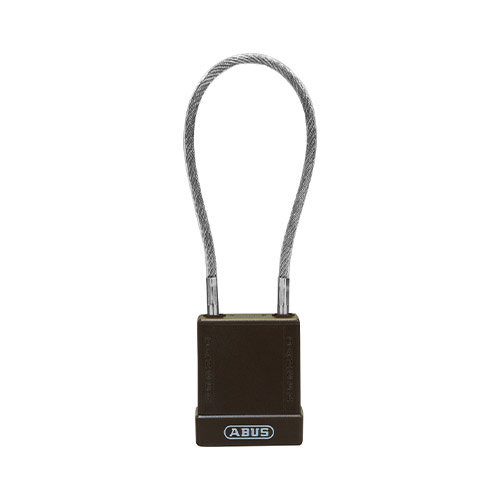





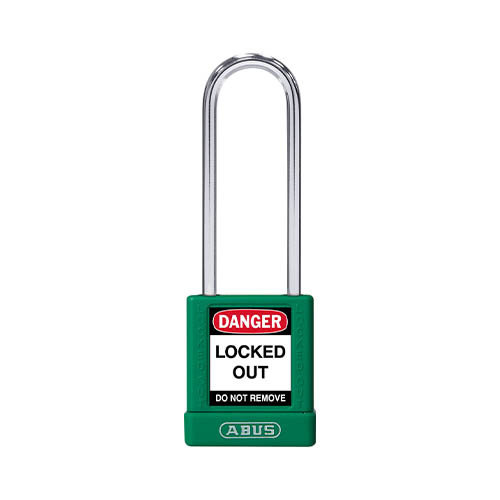

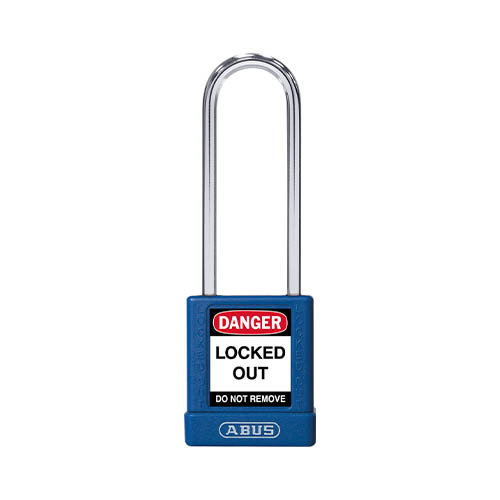

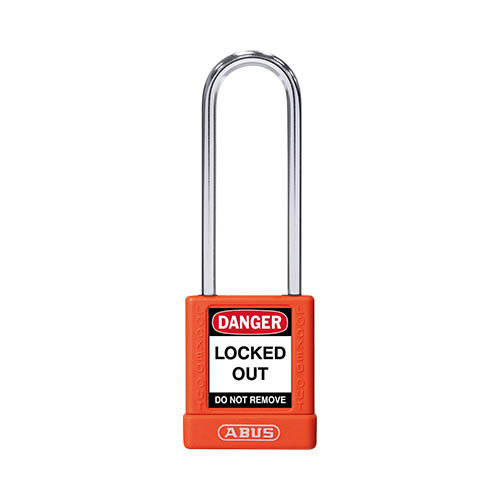
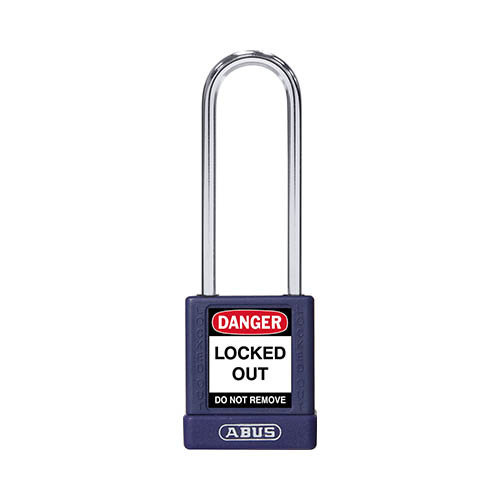


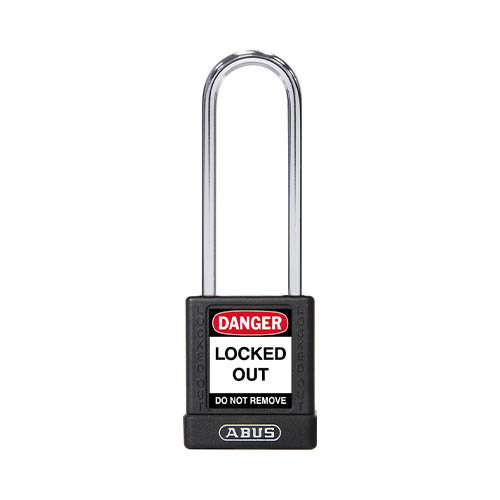
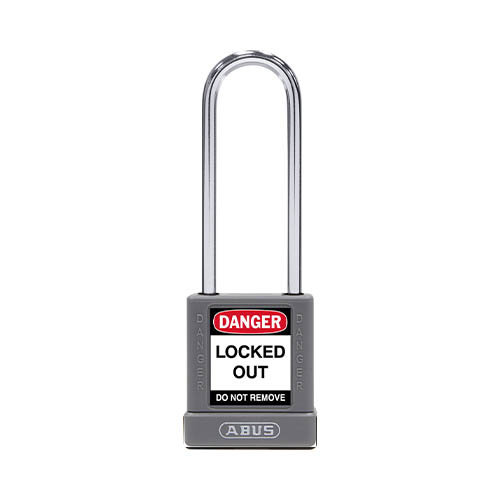

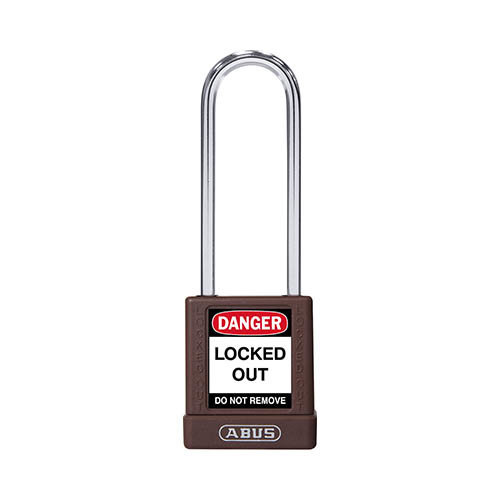

Composite-Covered Aluminium LOTO Safety Padlocks
Aluminium LOTO Safety Padlocks with Protective Cover
Aluminium safety padlocks with a protective plastic cover are used to secure energy-isolating devices during Lockout Tagout procedures. This category includes ABUS and Brady LOTO safety padlocks in different shackle materials, shackle dimensions, colours and keying configurations.
The correct configuration depends on the isolation point and the requirements of the energy-control procedure. The range includes models with steel, coated or insulated steel, stainless-steel and non-conductive plastic shackles, as well as extended shackles and flexible cable versions.
When selecting a padlock, it is therefore important to consider the complete padlock configuration rather than the lock-body material alone.
Why Use an Aluminium Safety Padlock for Lockout Tagout?
Aluminium provides a relatively lightweight metal lock body. A protective plastic cover helps protect the body and provides a clearly identifiable exterior that can be supplied in different colours.
For industrial Lockout Tagout applications, however, the most important selection criteria extend beyond the lock body. The shackle must fit the energy-isolating device, the selected materials must be appropriate for the working environment, and the keying configuration must support the organisation's LOTO procedure.
Important selection criteria include:
- shackle material;
- shackle diameter;
- free shackle height;
- electrical conductivity requirements;
- environmental and corrosion considerations;
- keying configuration;
- identification and colour coding;
- the geometry of the energy-isolation point.
ABUS and Brady Aluminium LOTO Padlocks
Lockout-Tagout-Shop offers aluminium safety padlocks with protective covers from ABUS and Brady. Both manufacturers offer solutions for Lockout Tagout, but the construction, cylinder, shackle options and keying possibilities vary between product ranges.
For this reason, technical specifications should always be checked at product or series level. A specification stated for one ABUS or Brady model should not automatically be applied to another model in this category.
| Selection criterion | Options within the range |
|---|---|
| Lock body | Aluminium with protective plastic cover/coating |
| Shackle material | Steel, coated/insulated steel, stainless steel or plastic, depending on model |
| Flexible configuration | ABUS versions with plastic-coated stainless-steel cable |
| Standard shackle clearance | Approximately 38 mm on many models |
| Extended shackle clearance | Approximately 75–76 mm on selected models |
| Identification | Multiple body colours available |
| Keying | Different keying configurations depending on manufacturer and model |
ABUS 74 and 76 Series
A significant part of this category consists of ABUS 74 and 76 safety padlocks. Both ranges use aluminium lock bodies with protective covers and are intended for Lockout Tagout applications, but there are important technical differences between the two series.
ABUS 74 Series
The ABUS 74 series uses a solid aluminium lock body with an insulating plastic cover. Different configurations are available, including standard and extended shackle versions.
The 74 series uses a 6-pin precision cylinder. ABUS specifies up to 7,000 guaranteed different key combinations for this range. The key-retaining design means that the key can only be removed when the padlock is locked.
ABUS 76 Series
The ABUS 76 series provides a broader selection of shackle configurations. Depending on the model, the range includes steel, coated steel, stainless-steel and non-conductive plastic shackles, as well as flexible cable versions.
The 76 series uses an 8-pin cylinder. ABUS specifies more than 200,000 guaranteed different key combinations for this range. The padlocks also use a key-retaining design, meaning the key can only be removed when the padlock is locked.
This range of configurations makes the 76 series suitable for situations where the shackle material or geometry needs to be matched more closely to the energy-isolation point.
Selecting the Correct Shackle Material
The shackle is a critical part of a LOTO padlock. Its material affects mechanical properties, electrical conductivity and suitability for particular environmental conditions.
| Shackle type | Selection consideration |
|---|---|
| Steel | Robust metal construction for general industrial Lockout Tagout applications. Steel is electrically conductive. |
| Coated or insulated steel | Metal shackle with an additional protective or insulating layer. The electrical properties of the complete padlock must still be verified for the intended application. |
| Stainless steel | Suitable for applications where corrosion resistance of the shackle is an important selection criterion. Stainless steel remains electrically conductive. |
| Non-conductive plastic | Available on specific models for applications where a non-conductive shackle is required. |
| Flexible cable | Provides an alternative where the geometry of the isolation point makes a conventional rigid shackle difficult to use. |
The shackle material should therefore be selected according to the actual isolation point and working environment, rather than solely on the basis of the padlock body material.
Shackle Diameter and Clearance
A safety padlock can only secure an energy-isolating device if the shackle physically fits the designated lockout point. Both shackle diameter and free shackle height should therefore be checked before ordering.
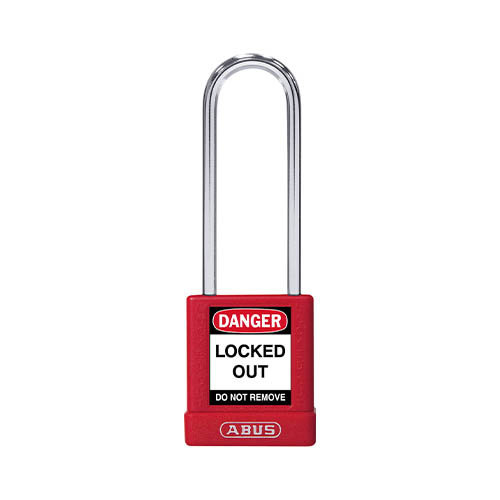
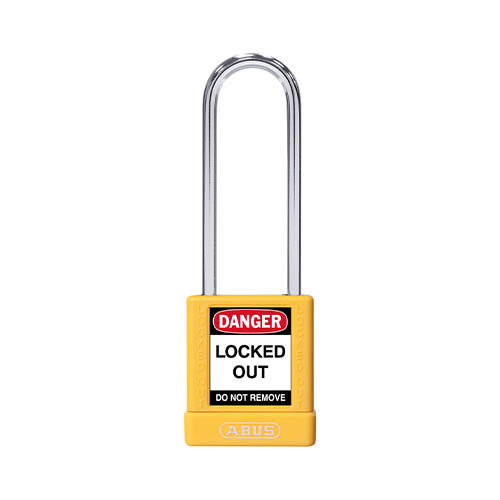
Many padlocks in this category have a free shackle height of approximately 38 mm. Selected models are available with extended shackles of approximately 75–76 mm.
| Configuration | Typical consideration |
|---|---|
| Standard shackle | Suitable where the isolation point is readily accessible and standard clearance is sufficient. |
| Extended shackle | Provides additional reach or clearance where the lockout point is recessed or difficult to access. |
| Flexible cable | Useful where a rigid shackle cannot easily pass through or around the designated lockout point. |
A longer shackle is not automatically a better choice. Use the configuration that provides sufficient access while remaining appropriate for the intended lockout point.
Electrical Conductivity: Check the Complete Padlock
Electrical properties require particular attention when selecting a LOTO safety padlock.
An aluminium lock body with a plastic or insulating cover should not automatically be described as a completely non-conductive padlock. Models fitted with steel or stainless-steel shackles still contain exposed or underlying conductive components.
Similarly, a coated metal shackle is not technically equivalent to a purpose-designed non-conductive plastic shackle.
Where electrical conductivity is relevant to the risk assessment, verify the construction and specifications of the complete padlock. The ABUS 76 range, for example, includes specific versions with non-conductive plastic shackles.
This distinction is particularly important when comparing visually similar padlocks: two models can have the same body colour and similar dimensions while using fundamentally different shackle materials.
Flexible Cable Padlocks for Difficult Isolation Points
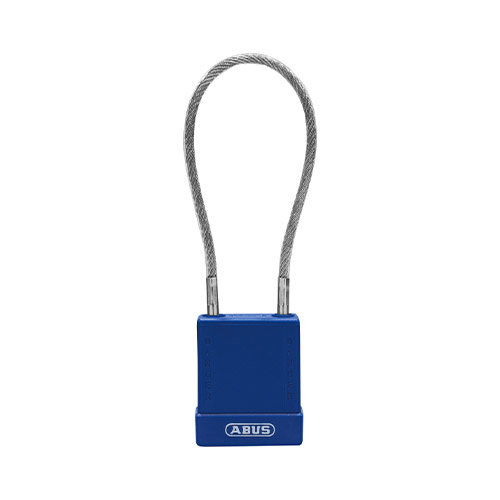
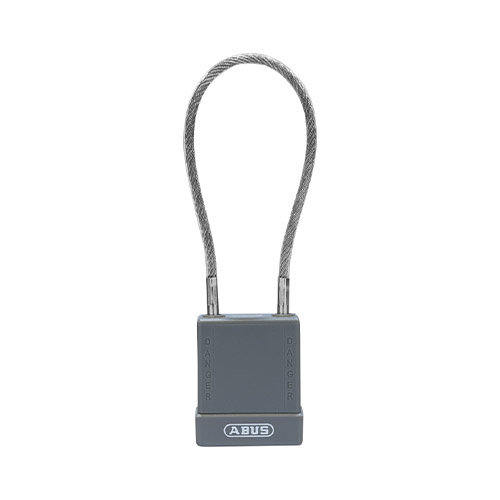
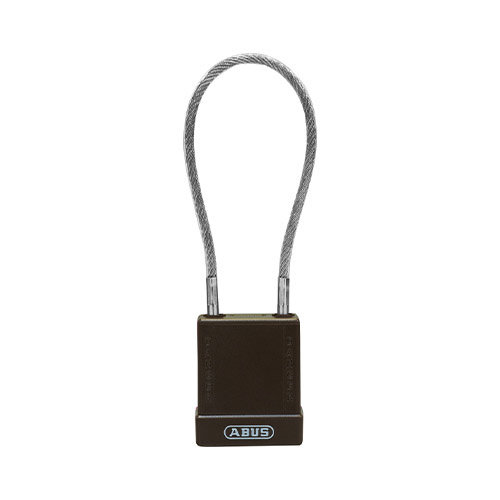
Some ABUS 76 configurations replace the conventional rigid shackle with a flexible, plastic-coated stainless-steel cable.
A flexible cable can be useful where the lockout point is recessed, has an unusual geometry or cannot easily accommodate a conventional padlock shackle. Different cable lengths are available within the range.
The cable configuration should still be matched to the specific isolation point. Check the cable diameter, length and product specifications before selection.
Colour Coding and Identification of LOTO Padlocks
Different padlock colours can support visual identification within an organisation's Lockout Tagout system. For example, an organisation may choose to use colours to distinguish between:
- departments or maintenance teams;
- employees and contractors;
- different sites or production areas;
- specific functions or applications.
There is no universal LOTO colour code that assigns the same meaning to each padlock colour in every organisation. If colour coding is used, the meaning of each colour should be defined in the organisation's Lockout Tagout procedure and communicated to the relevant personnel.
Colour should support identification; it should not replace the individual identification required by the organisation's energy-control procedure.
Keyed Different, Keyed Alike and Master Keyed
The keying configuration is another important part of a Lockout Tagout padlock system. Available configurations depend on the manufacturer and product series.
- Keyed Different (KD): each padlock has its own operating key. This configuration is commonly used for personal LOTO padlocks where individual key control is required.
- Keyed Alike (KA): multiple padlocks within a defined group can be operated by the same key. This can be useful in applications where one authorised person needs to control multiple locks, provided the arrangement is consistent with the organisation's LOTO procedure.
- Master Keyed (MK): an additional controlled key level is incorporated into the keying system.
A master-key system should not be used as a substitute for the individual control required for personal Lockout Tagout. Access to master keys and the circumstances in which they may be used should be clearly controlled within the organisation's procedure.
For larger systems, key planning is particularly important. Duplicate key codes, departmental structures and future expansion should be considered before ordering large quantities of safety padlocks.
Learn more about Lockout Tagout keying systems.
How to Select an Aluminium LOTO Safety Padlock
Before selecting a padlock, determine the requirements of the isolation point and the organisation's Lockout Tagout procedure. Check at least the following:
- Isolation point: where and how will the padlock be applied?
- Shackle diameter: will it fit through the designated lockout point?
- Shackle clearance: is a standard or extended shackle required?
- Shackle material: are there requirements relating to electrical conductivity, corrosion or the working environment?
- Rigid or flexible: does the geometry of the isolation point require a flexible cable?
- Keying: is KD, KA or a controlled master-key structure required?
- Identification: how will the padlock and authorised user be identified?
- Colour coding: does the organisation use a defined colour-coding system?
The correct LOTO padlock is therefore not determined by colour or body material alone. The complete configuration should support the specific energy-isolation point and the organisation's energy-control procedure.
Frequently Asked Questions About Aluminium LOTO Safety Padlocks
Are aluminium safety padlocks suitable for Lockout Tagout?
Yes. ABUS and Brady offer aluminium safety padlocks specifically intended for Lockout Tagout applications. The correct model should be selected according to the isolation point, working environment, required shackle configuration and the organisation's LOTO procedure.
Are aluminium LOTO padlocks electrically non-conductive?
Not necessarily. A plastic or insulating cover around an aluminium lock body does not automatically make the complete padlock non-conductive. Steel and stainless-steel shackles are conductive. Where electrical conductivity is an important selection criterion, check the complete construction and specifications of the selected model.
When should a non-conductive plastic shackle be used?
A non-conductive plastic shackle can be considered where electrical conductivity is relevant to the application or risk assessment. It should not be assumed that every padlock with a plastic-covered body has a non-conductive shackle; this is a model-specific feature.
How do I determine the correct shackle size?
Check both the shackle diameter and the free shackle height against the designated hole or attachment point on the lockout device or energy-isolating device. Extended shackles provide additional clearance, but should only be selected where that additional reach is required.
What is the difference between the ABUS 74 and 76 series?
Both are aluminium safety-padlock ranges for Lockout Tagout, but their technical configurations differ. The ABUS 74 series uses a 6-pin precision cylinder, while the ABUS 76 series uses an 8-pin cylinder and is available with a broader range of shackle configurations, including specific steel, stainless-steel, plastic and flexible cable versions.
When is a flexible cable padlock useful?
A flexible cable configuration can be useful where the geometry or accessibility of an isolation point makes a conventional rigid shackle impractical. The cable length and diameter should always be checked against the intended application.
Can colour coding be used to identify LOTO padlocks?
Yes. Padlock colours can form part of an organisation's visual identification system, for example to distinguish between departments, employee groups, contractors or applications. There is no universal LOTO colour code, so the meaning of each colour should be defined in the organisation's Lockout Tagout procedure.
Should personal LOTO padlocks be Keyed Different?
Keyed Different is commonly used for personal Lockout Tagout because each padlock can have its own operating key. The appropriate keying configuration should ultimately be determined by the organisation's energy-control procedure and requirements for individual key control.
Can aluminium LOTO padlocks be supplied Keyed Alike or Master Keyed?
Depending on the manufacturer, series and configuration, Keyed Alike and Master Keyed systems are available. For larger installations, the keying structure should be planned in advance to support controlled key management and future expansion.
View our complete range of Lockout Tagout safety padlocks to compare different body materials, shackle configurations and keying systems.