
















LOTOTO tools: an overview of important lockout tagout devices and solutions
- Posted on
- By Marit Krol
- Posted in ball valve, butterfly valve, group loto, lockout tagout, loto devices, safety padlocks
- 0
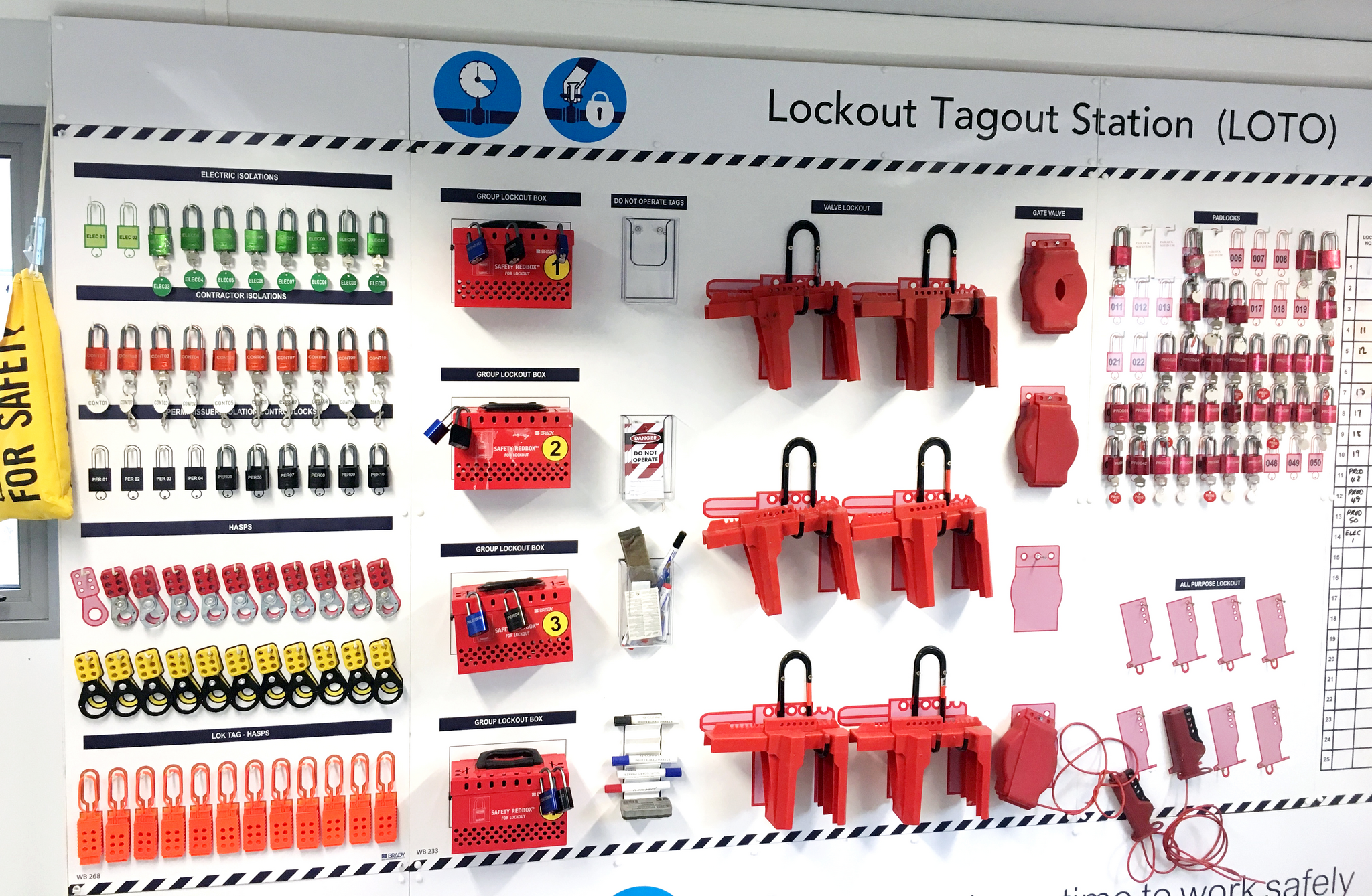
At workplaces involving machinery and installations, isolating energy is essential. Lockout Tagout (LOTOTO) prevents machines from being unintentionally started during maintenance. Various tools are used for this purpose, each with a specific function. This article provides an overview of LOTOTO equipment, including practical applications and key considerations.
What is LOTOTO equipment?
LOTOTO equipment includes all devices used to safely isolate energy sources and to clearly indicate that work is in progress.
It always involves a combination of three functions:
- Physical isolation of energy
- Prevents an energy source from being reactivated
- Clear communication on the work floor
- Indicates that work is being carried out on the installation
- Personal protection of employees
- Ensures that each employee maintains control over their own safety
These three elements together form the basis of an effective LOTOTO procedure. The absence of any one of these elements almost always results in an increased risk.
1. Safety padlocks (the basis of LOTOTO)
The personal padlock is the most fundamental component of LOTOTO. Without a padlock, there is no physical guarantee that an energy source remains isolated. Within LOTOTO, one strict principle applies:
Each employee applies their own personal lock.
This ensures that safety does not depend on procedures or agreements, but is physically secured. As long as a lock is in place, the installation cannot be reactivated without this being immediately visible. In practice, this prevents situations where an installation is accidentally or unintentionally restarted while work is still being carried out.
Colours and identification
Safety padlocks are deliberately designed to be clearly recognisable. In many organisations, colour coding is used to distinguish between different groups, such as internal employees, contractors, or specific departments. This is not for aesthetic reasons, but for functionality: when multiple locks are present at a single isolation point, it must be immediately clear who is involved.
In addition to colour, personal identification is essential. A lock must always be traceable to a specific individual. This is typically achieved through:
- name labels
- engraving
- stickers or photo identification
Without clear identification, uncertainty about ownership arises. In such cases, an installation must not be released, which can lead to delays and safety risks.
Key management
There are three systems:
- Keyed different → Each lock has a unique key. This is the standard and safest solution.
- Keyed alike → Multiple locks can be opened with the same key, but only within use by one person. This is applied when one person needs to lock multiple energy points simultaneously.
- Master key → A master key can open multiple locks. This may only be used under a strictly controlled procedure, for example in the absence of an employee.
Incorrect key management directly undermines the principle of personal safety and must therefore always be strictly controlled.
2. Group LOTO (working with multiple persons)
In many maintenance situations, multiple employees work simultaneously on the same installation. In such cases, individual locking alone is not sufficient; coordination is required without compromising personal safety.
Group LOTO ensures that:
- each employee remains individually protected
- energy can only be restored once everyone has finished
Lockout hasps
A lockout hasp makes it possible to place multiple padlocks on a single isolation point. This is necessary because a switch or valve usually has only one attachment point. The principle is simple but effective: as long as one lock is present, the energy remains isolated. This prevents any employee from releasing the installation while others are still working.
Lock boxes
In larger installations, multiple energy points are often involved. Instead of each employee locking all points individually, a lock box is used.
Procedure:
- All energy points are locked
- The keys are placed in a central box
- Each employee places their personal lock on the box
As long as one lock is present, the keys—and therefore the energy—remain inaccessible. This system provides structure in complex situations and prevents errors when releasing installations.
3. Tags and labels
While a padlock ensures physical safety, tags and labels provide communication.
A LOTOTO tag indicates:
- that an installation is locked
- who is responsible
- why the lock has been applied
Typical information on a tag:
- employee name
- date
- reason for locking
- contact details
An important principle is that a tag is never a substitute for a lock. A label cannot physically block an installation and therefore does not provide protection. The combination of lock + tag ensures both safety and clarity on the work floor.
4. Lockout devices per energy type
Not every energy source can be isolated in the same way. Therefore, different types of lockout devices exist, tailored to the type of installation.
Electrical
Applied to:
- main switches
- circuit breakers
- isolators
These devices lock the switch in the OFF position, after which a padlock is applied.
Valves
For systems with liquids, gases, or steam, valves are locked, such as:
This prevents pipelines from being opened unintentionally.
Pneumatic
For compressed air systems, shutting off alone is not sufficient. Residual pressure must always be released to prevent uncontrolled movement.
Cable lockouts
Cable lockouts are used when:
- multiple energy points must be blocked simultaneously
- standard lockout devices do not fit
A cable is routed through multiple points and secured with a padlock.
5. Shadow boards
Shadow boards provide structure in managing LOTOTO equipment. All tools have a fixed location, making it immediately visible:
- which equipment is available
- what is in use
- what is missing
This supports consistent application of LOTOTO and prevents employees from starting work without the proper equipment.
6. Pipe and energy identification
In complex installations, it is not always immediately clear where specific energy sources are present. Pipe marking makes this visible through:
- colour coding
- flow direction
- identification of contents
This helps employees quickly identify the correct isolation point and prevents errors such as shutting off the wrong line.
7. Digital LOTOTO systems
In larger organizations or complex installations, LOTOTO is often supported by digital systems.
These systems enable:
- registration of energy sources and isolation points
- documentation of procedures
- recording of work activities
- execution of audits and inspections
Examples of such systems include:
- ABUS One LOTO (focus on lock and key management)
- Brady Link360 (procedure management and visual instructions)
- Master Lock eLOTO (management and compliance)
- Digital support improves oversight and helps ensure LOTOTO is applied in a structured and consistent manner.
Comments
Be the first to comment...